
Pisanki
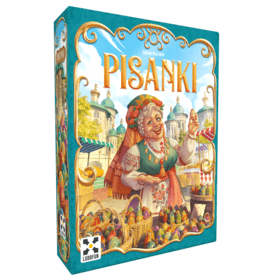 Pisanki is de traditionele kunst van het beschilderen van paaseieren, die door Slavische volkeren, voornamelijk in Polen en Oekraïne, wordt gevierd.
In dit spel maak je de mooiste presentatie van Pisanki-eieren om mensen over de hele wereld te verrassen.
Elke ronde onthullen en verwerven spelers nieuwe kaarten met daarop versierde eieren, bloemen en tafelkleden, om hun presentatietafel samen te stellen.
Afhankelijk van de volgorde waarin de kaarten worden verkregen, kan de speler ook bewegingspunten verdienen om de kaarten op zijn tafel te sorteren. Deze punten worden aan het einde van het spel geteld op basis van hun positie ten opzichte van de andere kaarten en op basis van de scorekaarten die aan het begin van het spel zijn vastgesteld.
De speler met de meeste punten wordt als winnaar beschouwd.
Aantal spelers: 2 - 5
Spelduur: 7 mn
Complexiteit: 1 / 5
Speel Pisanki en 1414 andere spellen online.
Geen download nodig - speel rechtstreeks in je webbrowser.
Met je vrienden en duizenden spelers van over de hele wereld.
Gratis.


Speel Pisanki en 1414 andere spellen online.
Geen download nodig - speel rechtstreeks in je webbrowser.
Met je vrienden en duizenden spelers van over de hele wereld.
Gratis.
Samenvatting van de regels
Pisanki - Quick Rules
Pisanki is a strategic card game where players collect and arrange decorated Easter eggs (Pisanki) on their display table to score the most points through clever positioning and majorities.
Gameplay Flow
The game lasts several rounds. Each round consists of the following phases:
1. Preparation Phase
- Depending on the number of players, cards are drawn from the deck and placed face-up next to the numbered Offer Cards (1 to 5).
- These cards feature combinations of eggs, flowers, and different tablecloth backgrounds.
2. Acquisition Phase
- Starting with the lead player, each player chooses one of the available cards.
- Choosing a lower-numbered card grants a better turn order position for the next round.
3. Placement and Sorting Phase
- The acquired card must be placed immediately into the player's Display Table (a 3x4 grid).
- Using Movement Points:
- If the player purchased 1 card, he will have 2 moves to make
- If the player purchased 2 card, he will have 1 move to make
- 1 move:A card can be moved vertically or horizontally to any position in that direction; the other cards in the column or row must be slid to fill the empty space.
- 2 Points: The same card can be moved twice (if the player has 2 moves).
Categories and Symbols
When choosing cards, players should consider these key elements:
- Egg Types: There are 6 different patterns/colors. These are vital for majority scoring.
- Flowers: Found on some cards. They provide bonus points based on the active Flower scoring cards.
- Tablecloths (Backgrounds): The color or pattern of the background influences tablecloth scoring (e.g., groups of matching colors).
- Double Eggs: Cards showing two eggs count twice for majority checks.
End of Game and Scoring
After 12 rounds, the 3x4 display is full. Scoring occurs in four categories:
- Egg Majorities: The player with the most eggs of a specific type wins the points on the corresponding scoring card.
- Flower Scoring: Points based on the total number of flowers collected.
- Tablecloth Scoring: Points for the arrangement and patterns of the card backgrounds.
- Display Scoring: Points for meeting specific objectives (e.g., specific eggs in the corners of the grid).
The player with the highest total score wins.