
Paikō
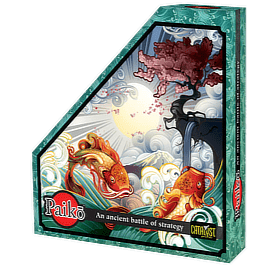 In Paiko, een één tegen één abstract strategiespel, is je hoofddoel om je tegels te verspreiden en die van je tegenstander te blokkeren, met het slaan van tegels van je tegenstander als plezierig tweede doel.
In jouw beurt, je kan 1 van 3 dingen doen: plaats een tegel op het spelbord, verschuif een tegel die reeds op het spelbord ligt of neem 3 tegels naar keuze. Je start het spel met 8 tegels in de hand als je wit bent, 9 als je zwart bent. Omdat Paiko 8 verschillende soorten tegels heeft, is het kiezen van je starthand heel strategisch alsook in de keuze wanneer je je hand terug aanvult door het trekken van tegels.
Je wint Paiko door 10 punten te verdienen en je verzamelt punten door je tegels op agressieve plaatsen op het bord te plaatsen.
Aantal spelers: 2
Spelduur: 38 mn
Complexiteit: 2 / 5
Speel Paikō en 1403 andere spellen online.
Geen download nodig - speel rechtstreeks in je webbrowser.
Met je vrienden en duizenden spelers van over de hele wereld.
Gratis.


Speel Paikō en 1403 andere spellen online.
Geen download nodig - speel rechtstreeks in je webbrowser.
Met je vrienden en duizenden spelers van over de hele wereld.
Gratis.
Samenvatting van de regels
Overview
Paikō is a 2players player abstract strategy game where players take turns deploying tiles on the board and shifting them to advance out of homeground in order to score 10 points and win the game.
Game Board
The game board is made of squares arranged in a diamond pattern. Pieces are deployed in and shifted between the squares. 4 black squares in the middle of the board are inaccessible except to Lotus tiles.
Half squares at the edges of the board serve only decorative purpose and are not part of the game.
The board is split into 4 quarters, of which 2 opposite ones are homegrounds of respective players, and the other 2 are middleground. Having a tile in middleground is worth 1 point, and having a tile in opponent's homeground is worth 2 points.
Each square can be threatened and/or covered by nearby tiles. Threat from a friendly tile allows a player to capture opponent's tiles and also deploy own tiles further away from homeground. Cover protects from a single opponent's threat, but only when checking for capture. While threat is cumulative, cover is not. Homeground squares are always in cover.
Tiles
Each player starts with black or white 24 tiles in their reserve, 3 for each of 8 tile types. Tiles in reserve cannot be used directly and first need to be drawn into player's hand. Once in hand, tiles can be deployed on the board and then shifted. Players draw some tiles (8 for white, 9 for black) into their hands before start of the game.
A tile on the board can be rotated to face any of the 4 orthogonal directions. Each tile has its own pattern of threat and cover that is projected from the tile's position and follows the tile's rotation.
Some of the tiles feature exceptions to the rules that are listed in respective tooltips.
Gameplay
During their turn, each player takes a single one of the following actions:
- 🔴 Draw: take up to 3 arbitrary tiles from reserve and add them to your hand.
- 🔴 Deploy: place a tile from your hand on any square not threatened by your opponent that's either in your homeground or threatened by your tile, then rotate it by any amount.
- 🔴 Shift: move one of your tiles on the board up to 2 squares orthogonally, then rotate it by any amount. It's not possible to move through squares with enough threat for the tile to be captured. Additionally, a single tile cannot be shifted 4 times in a row.
After the action is completed, check for captures. Any action that would result in any of your tile being captured at the end of your turn is not allowed.
Captures
A tile is captured when its square is threatened by at least 2 opponent's tiles (or 3 tiles when in cover). A captured tile is removed from the board which can cause additional tiles to be captured as well. The order of captures is chosen so that as many tiles as possible are captured. Fire tiles are captured all at once, even if they threaten each other.
The owner of each captured tile must choose 1 tile for the opponent to draw from reserve.
End of the game
The game ends in a victory for the player who scores 10 points first. However, if each player has lost 13 or more tiles and has 5 or fewer points the game ends in a tie.