
Forage
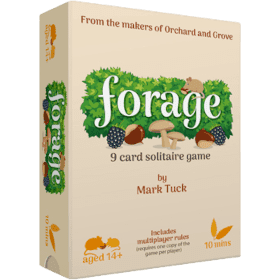 Forage is het laatste deel van de trilogie met 9-kaarten solitairespellen (na Orchard en het vervolg Grove).
De 18 kaarten tonen verschillende soorten bosgebieden, waar je wilde bramen, tamme kastanjes en eetbare paddenstoelen vindt. Sommige gebieden zijn verdeeld in twee typen die, samen met de aangepaste dobbelstenen met hongerige bosmuizen, nieuwe kansen en verschillende strategieën bieden om je oogst te vergroten.
De achterkanten van de kaarten bevatten receptenuitdagingen met verschillende scorevoorwaarden en doelscores. Deze bieden een win/verlies-voorwaarde (als alternatief voor het standaardspel 'versla je score') voor degenen die dat prefereren – en voegen nog meer variatie toe aan het spel.
Aantal spelers: 1
Spelduur: 5 mn
Complexiteit: 1 / 5
Speel Forage en 1414 andere spellen online.
Geen download nodig - speel rechtstreeks in je webbrowser.
Met je vrienden en duizenden spelers van over de hele wereld.
Gratis.


Speel Forage en 1414 andere spellen online.
Geen download nodig - speel rechtstreeks in je webbrowser.
Met je vrienden en duizenden spelers van over de hele wereld.
Gratis.
Samenvatting van de regels
Forage (Herbsthain)
Forage is a solo card-layering game where the player overlaps forest cards to create large groups of identical berry and fruit symbols. The goal is to achieve the highest score through clever placement and the strategic use of dice.
Game Objective
Reach the highest possible score by overlapping cards and forming groups of identical symbols. The game ends once all 18 cards in the deck have been played.
Game Setup
- Shuffle the 18 cards.
- Draw 2 cards as starting cards and place them side-by-side or slightly overlapping.
- Draw one card into your hand. The remaining cards form the draw pile.
- Keep the dice ready to mark points on the cards.
Gameplay
The game consists of a series of turns until the draw pile is empty and the final hand card has been played. A turn follows these steps:
1. Place Card
- Play your hand card onto the cards already on the table.
- Overlapping Rule: The new card must cover at least one square of a card already in play.
- Matching Symbols: If you cover a symbol (e.g., blackberries) with an identical symbol on the card below, you earn points.
2. Mark Points (Dice)
- When symbols match, place a die on the square of the topmost card.
- First Match: Place a die showing the number 1 on the square.
- Subsequent Matches: If you later overlap an identical symbol onto a square that already has a die, increment the die value (1 → 3 → 6 → 10 → 15, the last value is reserve for the mice).
- Maximum Value: A die can reach a maximum value of 15.
3. Draw
- Draw a new card from the pile into your hand (while supplies last).
Special Rules & Symbols
The Path (Trail Symbols)
- Many cards show sections of a forest trail.
- By aligning or overlapping paths correctly, you create a continuous trail.
- Trail Bonus: At the end of the game, you earn extra points for your longest continuous path of trail symbols.
Forks and Crossings
- Some cards allow the path to branch in different directions. These are vital for staying flexible as new cards are drawn.
Final Scoring
After the 18th card is placed, calculate the final score:
- Berry Points: Sum the values of all dice currently on the cards.
- Trail Points: Count the number of trail symbols in your longest continuous path (each symbol equals 1 point).
- Penalties: Depending on the difficulty level or scenario, points may be deducted for uncovered "rotten" symbols or isolated squares.
Player Decision Factors
- Efficiency: Is it better to start a new symbol group (value 1) or increase an existing die?
- Path Planning: Should I extend the trail or sacrifice a path segment to complete a high-scoring berry combination?
- Card Management: Which symbols are still left in the deck? (Strategic planning for the remaining turns).