
De Alchemist
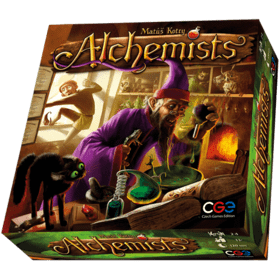 In Alchemists strijden twee tot vier opkomende alchemisten om de geheimen van hun mystieke kunst te ontdekken. Punten kunnen op verschillende manieren worden verdiend, maar de meeste punten worden verdiend door theorieën te publiceren - dwz juiste theorieën - en daar ligt het probleem.
Het spel wordt gespeeld in zes rondes. Aan het begin van elke ronde kiezen de spelers hun speelvolgorde. Wie later speelt, krijgt meer beloningen.
Spelers verklaren al hun acties door blokjes op de verschillende actievelden te plaatsen, waarna elk actieveld in volgorde wordt geëvalueerd. Spelers vergaren kennis door ingrediënten te mengen en de resultaten te testen met behulp van een smartphone-app, die de alchemieregels voor elk nieuw spel randomiseert. En als de alchemisten verlangen naar iets nog specialers, kunnen ze altijd magische artefacten kopen om een extra boost te krijgen. Er zijn er 9 (verschillend per spel) en ze zijn niet alleen erg krachtig, maar ook erg duur. Maar geld betekent niets als er academische trots op het spel staat! En het bezit van deze artefacten levert je zeker ook wat reputatie op. Spelers kunnen ook geld verdienen door drankjes van twijfelachtige kwaliteit aan avonturiers te verkopen, maar geld is slechts een middel tot een doel. De alchemisten willen immers geen rijkdom. Ze willen respect, en respect komt meestal voort uit het publiceren van theorieën.
Tijdens het spel zullen de reputaties van spelers omhoog en omlaag gaan. Na zes ronden en een laatste tentoonstelling, zal reputatie worden omgezet in punten. Punten zullen ook worden geteld voor artefacten en subsidies. Dan worden de geheimen van alchemie onthuld en scoren of verliezen spelers punten op basis van of hun theorieën juist waren. Wie de meeste punten heeft aan het einde van het spel wint.
Maar welke mysterieuze geheimen verbergen deze vreemde ingrediënten? Nu is het tijd om daar achter te komen. Meng ze tot toverdranken en drink ze op om de effecten te bepalen – of speel op veilig en test het brouwsel op een behulpzame assistent! Vergaar rijkdom door toverdrankjes te verkopen aan rondtrekkende avonturiers en investeer deze rijkdom in krachtige artefacten. Naarmate je kennis groeit, groeit ook je reputatie, terwijl je je theorieën met iedereen deelt. Kennis, rijkdom en roem zijn allemaal te vinden in de duistere diepten van de alchemistenketel.
Aantal spelers: 2 - 4
Spelduur: 41 mn
Complexiteit: 4 / 5
Speel De Alchemist en 1388 andere spellen online.
Geen download nodig - speel rechtstreeks in je webbrowser.
Met je vrienden en duizenden spelers van over de hele wereld.
Gratis.


Speel De Alchemist en 1388 andere spellen online.
Geen download nodig - speel rechtstreeks in je webbrowser.
Met je vrienden en duizenden spelers van over de hele wereld.
Gratis.
Samenvatting van de regels
Overviews
Overview of Favour Cards
Assistant (4x): Play when you declare actions. For this round, you have 1 extra action cube.
Associate (3x): Play when you declare actions. Choose one action space. On that space, your cubes go in the top row.
Barmaid (2x): Play when it is your turn to sell a potion. If you mix an exact match, you gain 1 point of reputation. If not, count the potion as one level better than it is.
Custodian (3x): Play when you declare actions. Place one cube on this card. For this round, that cube is a special Drink Potion action that you may use before the Sell Potions action space.
Herbalist (4x): Play immediately. Draw 3 ingredients. Then discard 2 ingredients.
Merchant (2x): Play when it is your turn to sell a potion. If you sell first, gain 1 gold piece. If not, you may sell any of the three potions, as though you were first.
Publisher (2x, promo card): Play instead of your Debunk Theory action. On one theory, exchange your seal with one of your unused seals. If yours is the only seal, you may (instead or in addition) exchange the alchemical with an unused alchemical.
Sage (2x): Play when you transmute an ingredient. Gain 1 extra gold piece during transmutation.
Shopkeeper (2x): Play when you buy an artifact. The selected artifact costs you one gold piece less.
Scoring Overview
You gain VP for:
- Reputation points (1:1)
- Artifacts
- Grants (1 or 2 VP)
- Gold coins and favour cards (favour cards are converted into 2 gold, for every 3 gold you then gain 1 VP)
- Gold- and silver-starred seals on correct theories (5 and 3 VP respectively)
- Any seal not properly hedged on a wrong theory (-4 VP)
Apprentice and Master Variant
1. Apprentices gain one more ingredient at the beginning (A 3 ingredients vs. M 2 ingredients)
2. Apprentices have lower conference thresholds (1st conference A: 1 theory → +1 rep, 0 theories → -1 rep, M: 2 theories → +1 rep, 1 theory → -1 rep, 0 theories → -2 rep, 2nd conference A: 2 theories → +1 rep, 1 theory → -1 rep, 0 theories → -2 rep, M: 3 theories → +1 rep, 2 theories → -1 rep, 1 theory → -2 rep, 0 theories → -3 rep)
3. Debunking works differently (see below)
Rules
In this worker placement deduction game you need to discover the properties of eight ingredients and which potions you can concoct by mixing them. And if you can't, you must at least act like you do, because in this hard science game it's all about your reputation as a genius scientist.
Deduction
There is a system to this madness though, because each ingredient corresponds to a certain alchemical. Each alchemical has a red, a green and a blue aspect and these aspects can be positive or negative (sign) and large or small (size). Mixing two alchemicals, you create the potion associated with the unique aspect in which they share the same sign but different size (e.g. the red large +, blue small -, green small + alchemical mixed with the red small +, blue small -, green big - alchemical yields a red + potion).
Each alchemical also has an opposite, with which it creates a neutral potion. The neutralising alchemicals are listed as pairs on your deduction board (lower right on your screen).
As you discover which pairs of ingredients result in which potion, you can exclude ever more possibilities on your deduction board to determine which ingredient corresponds to which alchemical. You need this in order to sell better potions to adventurers and publish good science in academic journals.
Round Overview
The game goes for six rounds. In each round, each player, starting with that round's starting player, places their flask on an order space and immediately receives the bonus (favour cards and/or ingredients) or has to pay 1 coin for the uppermost space.
Then players declare which actions they will take this round by placing their action cubes at the various actions. In round 1, you have 3 action cubes available. Subsequently, you have 6/5/4 cubes with 2/3/4 players. The players declare in the order bottom to top of the order track.
Now, all the different action spaces are handled clockwise, starting with the bottom right (gather ingredients). For each action, the cubes get their turn one column at a time and from top to bottom in each column. You can always choose not to use the action with your cube(s) and place it/them in the unused cube box instead.
At the end of each round, the player with the most seals on the theory board receives 1 reputation. All cubes in the unused cube box are returned and you gain a favour card for every two you had there. All cubes from the hospital are now placed in the unused cube box for next round. A new adventurer is placed on the sell potion space that you can now sell potions to. Starting player moves down one player.
At the ends of rounds 3 and 5 there is a conference. Players with a sufficient number of seals on the theory board gain 1 reputation, others lose 1 or more (cf. Apprentice and Master variant). Subsequently, new artifacts are placed in the market, replacing any remaining old ones.
At the end of round 6, the game ends with round 6's special action, the exhibition.
Actions
Gather ingredients
Take an ingredient from the market or the topmost card from the pile.
Transmute ingredient
Turn one ingredient into one gold piece.
Sell potion
(only from round 2) Sell a potion to an adventurer. You must give a quality guarantee (4 coins: exact potion requested, 3 coins: sign correct but colour may be wrong, 2 coins: may be correct sign or neutral, 1 coin: any potion). You brew the potion with 2 ingredients from your hand and are given information as to its quality level (but not necessarily which exact potion it is). If you have matched or outperformed the guarantee, you get paid as many coins as your guarantee specified. If your potion was neutral or of the wrong sign, you always lose 1 rep. Prior to the sell potion action, you can offer a refund to get higher in player order for this action.
Buy artifact
Buy one of the artifacts on the board, paying its cost in coins (upper left of card). These give special abilities and/or VP at the end (upper right of card).
Debunk theory
(only from round 2): Attempt to debunk a theory. Apprentice variant: Specify an aspect of an ingredient (not from your hand). If this does not match the alchemical published for this ingredient, you have successfully debunked. Master variant: You must conduct a test with two ingredients (not from your hand) that shows that one or more theories must be wrong. To successfully debunk, either explicitly refute one or more theories or determine a conflict between two theories that then receive conflict tokens. Theories with conflict tokens no longer count at round's end and cannot be signed by other players until the conflict is resolved (by refuting one of the two theories). In any case: Successful debunking earns you 2 rep, failure loses you 1 rep. Any seals on refuted theories that were not hedged against the colour you used to refute the theory make the owner lose 5 rep. The alchemical token is returned, the seals are not. You can immediately republish, if you have a cube on the publish theory action.
Publish theory
(only from round 2): Pay 1 gold. Either publish a new theory, placing an alchemical token on the theory board (lower left on your screen) in the box of an ingredient that does not already have an alchemical. Place a seal there (gold or silver seal give 5/3 VP at game's end, other seals hedge against being wrong about the sign (+/-) of one of the aspects) and gain 1 rep. Or endorse an existing theory, paying 1 gold to each player that has already placed a seal there. If you qualify for any of the grants lying on the theory board, take it. Your first grant requires having signed theories of 2 of the 3/4 ingredients shown. Further grants require 3. Each grant gives you 2 gold and 1 or 2 VP.
Test on student
Mix 2 ingredients from your hand and feed the concoction to the anxious student. The result is displayed on your theory board and every other player finds out which result you obtained (but not which ingredients you used). If the student has already drunk a negative potion earlier this round, you must pay them 1 gold to conduct the experiment, no matter the result of your own potion.
Drink potion
The same but you test the potion on yourself. If you drink a positive or neutral potion, nothing happens. If you drink red-, place one cube in the hospital. You won't be able to use it next round. If you drink green-, you are paralysed and will move to the lowest space on the order track in the next round. If you drink blue-, lose 1 rep.
Exhibition
(6th round only, replaces the two testing actions as the last action of the game): Select a potion you want to exhibit. Select two ingredients from your hand. If they make the correct potion, place your cube in the respective column and, if you are the first to exhibit that potion, gain 1 rep. If you fail, lose 1 rep. If you successfully exhibit both signs of the same colour, gain 2 rep.
Additional Rules
Reputation Board
The reputation board contains four sections:
Red section (1-6 reputation): When you lose reputation, you immediately gain 1 back. You receive one gold coin less from selling potions.
Yellow section (7-13 reputation): Nothing special. You start the game at 10 reputation.
Green section (14-17 reputation): When you lose reputation, you lose 1 more. When offering a refund, you must offer one coin less to get the same refund level for playing order at this action.
Blue section (18+ reputation): When you lose reputation, you lose 2 more. When offering a refund, you must offer one coin less to get the same refund level for playing order at this action. You receive one gold coin more from selling potions.
If there are several functions making you lose and gain reputation at the same time, add all losses and gains together. If the sum is negative, apply the additional loss or gain once.